Written March 21
We’ve already made it through most of the month and thus far, if I were to give any advice from my experience here it would be to expect to invest a few weeks figuring out how your chosen Wwoofing farm works. It has taken us a good deal of time before I’ve started to feel like my efforts are well spent.
I’ve been on El Yunque for coming on three weeks, and it seems like every day we get started on something and it’s not exactly how it should be done, the right place to do it or we’re given weak instructions, so we’ll spend half a day’s work doing it wrong and be forced to do it all over again the following day.
The workers laugh at us. Our supervisor gets exasperated by us. And the farm owner is not here often enough to make sure instructions are conveyed correctly. The caretaker puts us to work in a spot far away so that he doesn’t have to worry about us all day. And by the end of it, the owner feels like the volunteer system is not producing as much as he hoped.
There is definitely a lot of trial and error going on. So one week at El Yunque would never do it. For us, the entire first week of our stay Miguel, the farm owner, wasn’t here. So Gabriel, a known cattle man, not a farmer, gave us busy work.
But it doesn’t go in vain. In our second week of work, Miguel finally arrived and gave us a run down. To be quite frank, before meeting him, we still knew very little about what the farm’s purpose was. It grows sweet potatoes, malanga, yucca, bananas, caribbean bananas, plantains, grapefruit, coffee and though that may seem like a lot combined with beans and rice, it is very hard on our diets.
Upon our arrival we were under the impression that the farm was producing for the community. Though it is giving many of the village’s country boys work, it doesn’t sell much. In fact, Miguel’s main purpose for the land is reforestation.
Over the years, Nicaragua’s beautiful topography has endured mighty deforestation. According to the Foundation for Sustainable Development, “Around 75 percent of Nicaraguan forests have already been transformed into crop and pasture land, and at least 50 percent of that deforestation has occurred since 1950.” Without the fertilization given by biomass like forests of trees plus pesticides (some of which are banned in the U.S.) the ruin of much of the land’s nutrition is inevitable. And this includes El Yunque, which is not only riddled with tree stumps but also went through generations of potato and coffee farming using pesticides that have left a fungus disease deep in the lands soil.
With 160 acres of land, Miguel bit off a lot to chew. A jaded man, but full of ideas and good intentions, he couldn’t care less about the coffee he grows. It’s the trees that matter.
So with that in mind, we have learned a lot about tree farming in the central highlands of Nicaragua, a unique temperate climate that requires step plots.
1. Plant Seeds: This we did mostly to re-energize our personal food garden that surrounds the cooking cabin.
— Pay attention to spacing for plants that require a lot of room to grow such as squash or watermelon.
— Certain plants can’t be watered from above, specifically tomato. Water will burn the leaves.
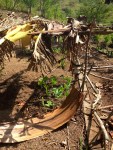
— Install a stable cover from the sun, as sprouts need time before they can handle the strength of the sun and it keeps the nutrient-rich soil from drying out and killing good micro-organisms. For our purposes, this was done by setting four poles in the ground to square up the small plot, laying two more poles across horizontally and lastly putting tons of banana leaves across the two poles to provide shade.
— To prepare for sowing: uproot weeds, turn the soil, fertilize with tons of grassy materials like rice husk and worm-worked compost (called mulching).
— Water early in the mornings. Some farms opt for evening watering, but for El Yunque where it gets cold in the night, the water could sit on top of the soil for hours before the plant absorbs it. Thus, encouraging fungus.
2. Mulching:
— It should look like a nest to keep surrounding soil fertilized with fresh nutrients and keep soil from drying out.
— A foot high of grassy materials surrounding baby plants.
— Around the base of the trees leave a circle about an inch in diameter of space between the tree and the mulch to prevent fungus.
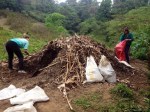
— In layers: compost soil, then grassy materials like old pulled weeds and last, a good technique if you have plenty of banana trees like El Yunque, place banana tree cuttings on top of mulch to provide constant watering. Banana trees are useful because when harvesting the fruit, you must chop down the entire tree. New saplings grow from the stumps of old trees. Once a tree is chopped down, you can use the leaves for both shading sprouts and nutrient-heavy mulch and then the trunk can be used for watering. The trunk is incredibly heavy, chock full of gallons of milky water. So you chop up the trunk into smaller chunks then pull off layers (like an onion) and place on top of your mulch.
3. Watering:
— On each plant, use approximately a third of a 5-gallon bucket of water.
— It’s a slow process that takes patience and physical strength on a farm with no irrigation system and nestled in the side of hills. Pour a little, wait for it to absorb, repeat.
— If you pour so much water that it runs away on top of the dirt before it is absorbed, you lose the water. Slow down. The plant needs the water, not the soil six inches away.
— The mornings are the best time, eight hours of wet soil overnight, will encourage a fast fungus growth.
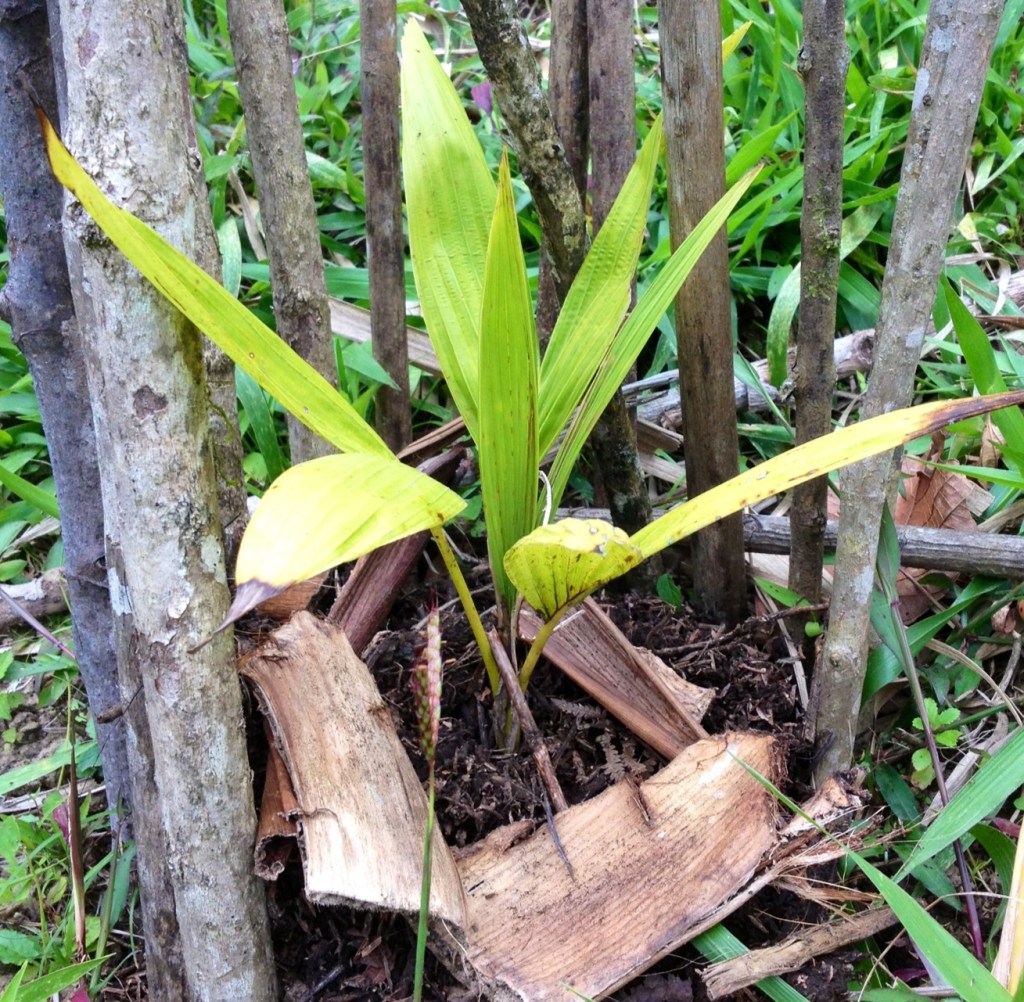
— For those crying plants that have turned yellow due to low nitrogen levels: mix the water with worm “tea.” It is essentially worm urine that is collected and drained out the bottom of the compost boxes into a barrel. Fill a bucket one part with tea and four parts water. Urine, including human urine, contains tons of nitrogen and are great for a starving plant. You can tell when the plant is starving for nitrogen when its leaves have turned yellow. So, that said, take initiative and pee outdoors in your home garden…
A large part of our volunteer duties are actually the most basic. Mulching and watering. Because in the end, the most important aspect to organic farming is up keeping what is already planted so it can continue to thrive.
 By Cecilia Garza
Leave a comment