Written March 22
Waves of nausea are forecasting my entire day today; emotionally, physically and mentally I’ve been letting the food in my stomach gurgle me into bed. But my dark mood is coming to the forefront. And my feelings toward this place extend further than just the day’s energy levels.
I must say, I don’t claim to be anything I’m not. I’m not yet as well-traveled as I hope to become in my adult life. I’m shaping that ambition right now. I am not as physically strong as I have been in former versions of me. But with every day and every stretch I make to soothe my sore muscles since I’ve left Washington, I feel my body becoming an able body. I am not as patient with my pace as I know I should be. In fact, most of my life I’ve struggled with this. I’ve bent over backwards to be as good, as smart, as strong, as athletic, as creative as my peers. I’ve cried over it. And I’ve put in the extra hours perfecting myself until I’m satisfied. But my patience is growing, as I know it should with adulthood. And in my work here, with patience, I’m beginning to see the way others think, feel and work to a point of, what I feel, is genuine empathy. I don’t snag the shovel out of anyone’s hands. I don’t have a smart reply every time someone points out how I can do something easier (though it took me a solid two weeks to hone that patience). I still feel my impatience flare when someone suggests I can’t handle a job, but in me, I know with maturity I will learn to use this to my advantage.
Because I know what I’m not, but I also know what I am.
1) I am a person who has made a lifestyle out of proving that life starts when you say it starts. 2) I am a person who acknowledges that there are many rivers of ideas, of people, of entire countries that separate us from each other. 3) I am a person who is willing to challenge these two things by making real actions and choices to cross some of these rivers and in effect change how I fit into the whole realm of life that we call the World. But it is no lie that it is a challenge. I am struggling. I am seeing my own limits to adaptation and questioning how far to push myself.
Time and time again, we have been told by the caretaker here at El Yunque or the farm owner himself, to do something over again because we did something wrong. We’ve been told at the end of the day that our entire day was spent working on something that didn’t need our work. I’ve been given a look of exasperation for asking for tools. I’ve been chuckled at when asking questions. At times I feel like I’m wasting my time just as much as their time because instructions are vague, I have to intuitively do a job rather than receive guidance, or I’m pointed to a plot by the caretaker to water and mulch that the farm owner doesn’t need me to do. Miscommunication, disorganization, and exasperation on all sides. It is lost in translation.
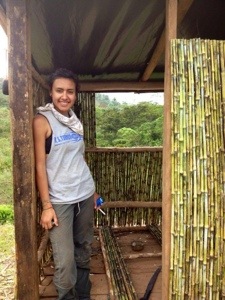
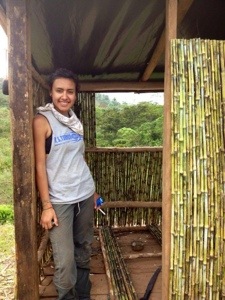
Amid the work, the atmosphere itself is off and on comfortable, nothing consistent. On the farm itself, I feel for the most part like I fit in. The workers chuckling at a girl shoveling is something I’ve been able to get over, though I find my annoyance and impatience bubble at times. I talk to them like they’re my peers, and I smile when I pass. It has gotten to a point where a few of the workers look to me for communication over the others whether to do a job or just have a conversation. It may be my physical attributes: dark hair, skin and eyes. It may be the way I look at them like I’m not scared or awkward, though that doesn’t change my shyness to speak to them. The discomfort happens when I find that I’m doing my job wrong, that I’m coming off weak or workers laugh at the volunteers. We try to ignore it.
Outside the farm, in the community itself, it is not easy either. San Antonio de Upa, is a place of sincere poverty. Most don’t know how to read or count. Children wear child size rubber boots and like everyone else, their clothes are dirty. Families live in three or two bedroom shacks. They are finely built with no power tools, eyeballing-it woodworking and materials that can be found nearby or bought cheap. Not a day goes by that we are not gawked at with expressionless faces staring from all directions. We stand out like a sore thumb. On the bus back from visiting Matagalpa, I sit among people from mountain towns much like San Antonio de Upa, and I can’t help but let my mind wander: what sort of elitism brings people like me to a place like this? People live and work like this their entire lives. There is no wonder why all the women are overweight sitting inside taking care of the children while the men have inner strength that has been trained and built into them since they were small children lugging jugs of water from the mountain springs. It is a place seemingly out of the 19th century. It is not an easy life, and yet, I chose to come here. People who have visited comparably impoverished places, often speak of an inner happiness from living simple that blooms out of the communities. I’m afraid to admit, thus far, I have no reason to believe this is one of those communities. And from what I understand, none of the village towns in the mountains are one of those communities. Grown men have never seen the ocean. Babies, from the age of 1 years old start drinking soda pop—many many adults have missing or rotting teeth capped with gold and silver. It seems like San Antonio de Upa is dominated by men, but, what I later realized, is the women don’t leave the house, so we hardly see them.
The farm owner and a few individuals on the farm and in town have shown a sincere interest in us being here. They want to know what kind of life we come from. They want to learn English or help us with our Spanish. But it’s hard and intimidating when we are a spectacle walking down the street or digging in a pile of cow dung. Men smile curiously when they see me, a woman, taking a break with a cigarette—a product of manual labor I didn’t understand until I began hauling 40-60lb sacks of mulch up and down hills every day. Children stare at Alex’s white legs when he wears shorts.
I think we are going to leave at the end of the week. It is time to stretch our legs. After logging almost a solid month on the farm, I think it will be respectable for us to move on and look for other ways to experience this country that we have so much more to learn about.
“Darwin wanted Patagonia to feel vast and romantic and exciting, the way it seemingly had for other travelers. Well, you can’t always get what you want. Sometimes it takes a while to sort out your mind, as it did for Darwin in Patagonia. Sometimes, modern life just hoofs right up and moos in your face, as it promptly did to Josh and me” Alex and I. —Eric Simmons in “Darwin Slept Here”

 By Cecilia Garza
Leave a comment