To view on Missouri Abroad website, click here.
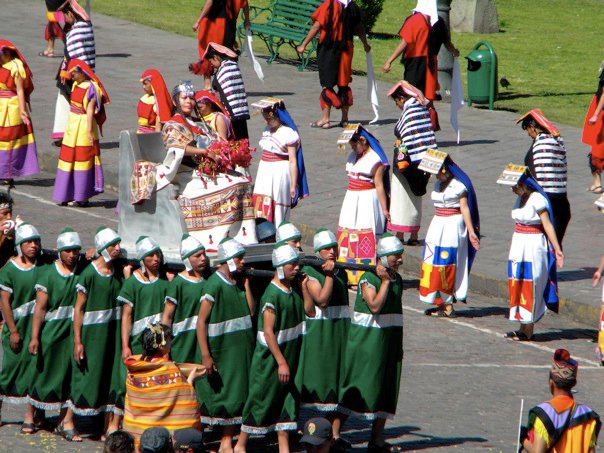
After about 15 minutes navigating the crowd with my roommate and a minor claustrophobic attack that sent tremors under my skin and a cold sweat on my forehead, we finally squeezed our way to the stairs leading up to Baghdad Café where we had reservations. Overlooking the Plaza de Armas, the main square of Cusco, my classmates and I watched from our balcony as a grand procession of over 500 actors dressed in traditional vibrant Inca costume reenacted an ancient tradition that dates back to before the invasion of the Spaniards in Latin America: Inti Raymi, the Festival of the Sun.
This tradition consists of dances, singing, and prayers all in the ancient language of Quechua. Before the Spanish banned the ceremony, and throughout underground efforts to keep the tradition alive, every Winter Solstice in Cusco when the sun is farthest from the earth, the Inca people would gather to honor the Sun God, fearing the lack of sun would result in famine. Banned in 1572 by Viceroy Toledo believing the ritual to be a contradiction to the Catholic way, it was re-institutionalized many years later in 1944 when the American Institute of Art in Cusco brought the festival back to life with massive reenactments by local actors. Today it is the second largest festival in Latin America, second only to Carnaval in Rio de Janeiro, with several fiestas and celebrations overtaking the streets of Cusco before and after the actual day event.
The days preceding Inti Raymi, also known as Carnaval Week, I experienced in many ways by accident while wandering the streets of Cusco and haphazardly falling on the celebrations. It was as if by June 15 the whole city of Cusco came alive in dance. Students from every school and grade were obligated to learn a separate dance to perform in several parades down Avenida el Sol, one of the main streets of Cusco. The first time I saw them, I was exploring the town in the evening with one of my new Peruvian friends, André. We had met up at the Plaza de Armas, as it is the typical meeting ground, and there were huge speaker systems being set up. I didn’t understand too much about the speakers and didn’t understand too well André’s brief but rapid explanation in Spanish, so I let it go to let him show me around Cusco. We walked down Ave. el Sol, and after a short distraction at a busy intersection where we both helped an elderly lady cross the street, we found ourselves at a smaller plaza where students in the age range of 14 – 16 stood practicing their “danzas,” as their instructors directed them with either a small drum or wooden flute. André explained they were practicing for Inti Raymi. At the time I assumed he meant that they were going to be dancing on the actual day of Inti Raymi, but later I would learn that Inti Raymi did not just mean one day of celebration. As dark began to fall, we began our trek back toward the Plaza de Armas. André, who was accustomed to the festivities, was surprised and intrigued at my widening eyes and noticeable curiosity as we emerged on the main square. Children around the ages of five to seven years, dressed in Incan costume and separated according to their schools, were performing their danzas to, what I thought at the time, an outstanding crowd of people. It was beautiful. I had never seen anything like it. Some of the groups were wearing incredibly intricate costumes with feathers on their jackets and bright colors on their hats. They proceeded to skip and twirl and flail their arms in synchronization to a large band of flutes, drums, and voices standing on top of the steps to the cathedral. This, I realized, was what the speakers system was for. We took a seat on the steps among the rest of the crowd and he explained that the dances and songs are ancient to the Inca people and he also had to perform these dances while in grade school.
The exuberance and pride that has been institutionalized in the Peruvian culture was just beginning to show itself to me. Two days later, while walking up Ave. el Sol to grab an ice cream after a long day of service projects, I fell upon another parade and found myself looking at the same group of kids I had seen practicing a couple days before in the smaller plaza. Today however they were dressed all in green and red outfits with the traditional Inca sandals on their feet.
Over the next few days, I would fall upon live concerts and fireworks in the Plaza de Armas as well as hear fireworks from my bedroom at home. In my free time spent at different plazas I would again see student groups performing or practicing. It became almost normal to find myself walking along a street as a marching band and group of people would pass me in a procession of song.
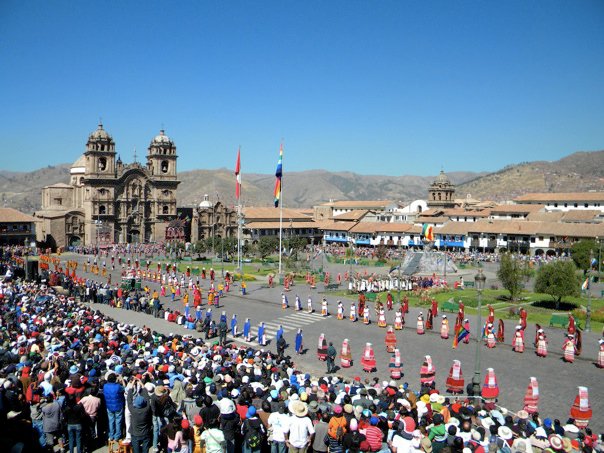
However, on Inti Raymi I was much further stunned at the mammoth crowd of people that had gathered and the grand organization of the procession. Starting around 10 o’clock in the morning at Qoricancha, the temple of the sun that was transformed into also the Convent of Santo Domingo during the Spaniard conquest, the procession takes itself through the city stopping at the Plaza de Armas for a reenactment of Inca prayer and ending at Sacsayhuaman, the ancient temple of the sun where the historical battle between the Incas and the Spanish took place, to reenact the tradition of sacrificing a llama to the Sun to ensure another year of good crops. This last part of the reenactment lasts till nightfall.
My host-mother’s sister traveled from Los Angeles with her 7-year-old son to Cusco and also her brother traveled from Lima all for the festivities. My host-home erupted with life that reminded me of family gatherings with my family in the U.S. Although it made me slightly homesick as we cleared the coffee table away and all danced in the living room or when we broke out a Peruvian version of Monopoly to play late into the night, it also did two things: made me feel even more a part of the family and made me realize the importance of a festival like Inti Raymi to the people of Peru. I’m sure we were not the only family in Peru to gather for such a celebration.

 By Cecilia Garza
Leave a reply to richard Cancel reply